Saturday, 24 December 2011

24th December 2011 Barcombe & West Rise Marsh Calm and clear

Black-necked Grebe 2 ex.
Goldeneye 1
Buzzard 2


First-winter Black-necked Grebe at Barcombe
The visibly buff-tinged neck and yellowy tint to the rear ear-coverts and pale neck patch are remnants of juvenile plumage rendering this individual a first-winter.

West Rise Marsh
Short-eared Owl 1

Friday, 23 December 2011

23rd December 2011 Birling Gap Seawatch 8.15am-9.15am SW4 Overcast & Cuckmere

Red-throated Diver 1E, 1W
Gannet 150E
Brent 6E
Merganser 1W
Scoter 3E, c.18 on sea
Auk sp. 6E

Upper Cuckmere
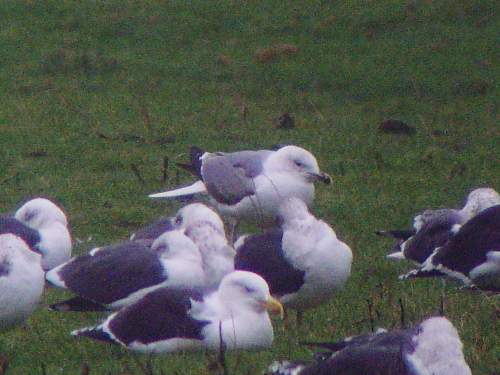
Lesser Black-backed Gull c.300
Great Black-backed Gull c.200
Caspian Gull 1 3w
Yellow-legged Gull 2 ad.

Third-winter Caspian Gull in the Cuckmere
An ultra-distinctive individual with such a snouty appearance complete with tiny black eyes, pear-shaped clean white head, mantle shade comparable with Common Gull and a very attenuated rear end being especially long-winged. It was also very long-legged and walked around with a characteristic gait and as if 'walking on tip toes'. The small white tips to its black primaries prove they are third-generation being those of  a 3w. 


When alert it appeared both long-necked and kink-necked.

Whilst its bill appeared that of a 2w being pale-tipped with a dark subterminal smudge that bled along its cutting edge towards its base its uniform pure grey mantle and only restricted dark centres to its tertials are characters strongly indicative of a 3w. Its bullet-hole dark eyes are characteristically tiny.

Its pure white tail lacking a broad black subterminal band and lack of hindneck streaking confirm its age as a 3w.

Caspian Gull is often described as peculiarly small-headed for the body and this individual is no exception.

In profile it is easy to appreciate the pear-shaped white head.


With such a sleek skeletal head, full-chested appearance, long pale fleshy-coloured thin weak-looking legs being particularly long in the tibia it appeared the archetypal Caspian Gull almost reminiscent of an Audouin's Gull.


Its tiny black eyes set upon its clean white head, long sloping forehead and never-ending lores all accentuate its snouty appearance. 


Whilst overall the wings appeared grey, some soft grey-brown patterning in the coverts was present. 

Flat-backed, lacking a tertial step and far longer-winged than argenteus it shared a mantle colour with the accompanying Common Gull. The small white tips to its primaries and restricted dark-centres to its tertials are just visible.

Third-winter Caspian Gull in the Cuckmere

Sunday, 18 December 2011

18th December 2011 Shinewater & West Rise Marsh NW1 Clear

Bittern 1 ex. fvo
Scandinavian Herring Gull 1 ad. presumed female
Cetti's Warbler 5+h


Adult female Scandinavian Herring Gull L.a. argentatus

This individual is presumably a female as it lacked the huge size and massive bill of some argentatus in that it appeared no larger than some of the accompanying argenteus. Measurements in Olsen & Larsson 2003 reveal that female argentatus can be smaller than male argenteus. The faint fleshy tones to the base of its bill, its dark blue mantle, extensive dusky head-streaking accentuating its 'evil-looking' pale eyes, coarse neck-blotching, broad white tertial crescent and large white tip visible on the underside of p10 are all compelling features of this form.

Saturday, 17 December 2011

17th December 2011 Beachy Head & West Rise Marsh NW2 Clear

Lapwing 1
Great Spotted Woodpecker 1
Skylark c.70
Rock Pipit 3+
Stonechat 3
Redwing 1
Mistle Thrush 1

West Rise Marsh
Yellow-legged Gull 2 (Ad & 1w)

The dark eye-mask set against its whitish head with a predominently black bill all help characterise this first-winter Yellow-legged Gull. It also has a pure white throat and centre to breast with rather neat hindneck streaking and brest-side spotting. Whilst its tertials are clearly worn they retain the narrow pale tips restricted to the distal part of each feather. In comparison with argenteus it appears rather attenuated and noticeably long-winged.

Despite its dar eye-mask it appears white-headed by virtue of its white lores, forehead, throat and neck-sides. Whilst its breast-sides are spotted a few chevrons are just visible on its flanks being typical of michahellis.

This image conveys how first-winter Yellow-legged Gulls can somewhat recall outsized first-winter Mediterranean Gulls! It is also displacing a scapular revealing its double-anchor marking the outer being a finer grey.

Whilst preening its white tail-base contrasted strongly with its black tail band that was broadest at its centre.

First-winter Yellow-legged Gull at West Rise Marsh

Saturday, 10 December 2011

10th December 2011 Beachy & West Rise Marsh W1 Clear

Fulmar 6
Scoter c.15
Red-legged Partridge 1
Common Gull c.200
Stock Dove 25
Great Spotted Woodpecker 1
Skylark c.35
Rock Pipit 1
Stonechat 2
Mistle Thrush 1
Chiffchaff 1
Goldcrest 1
Treecreeper 1
Raven 1

Chiffchaff at Birling Gap

Treecreeper in Belle Tout Wood

Mistle Thrush at Belle Tout

West Rise Marsh
Goosander 1 redhead
Yellow-legged Gull c.6+ adults
presumed hybrid Caspian x Herring Gull 1 adult


Adult Yellow-legged Gull at West Rise Marsh

Presumed hybrid Caspian x Herring Gull at West Rise Marsh

The reproduction of this blogged video is unfortunately not of the quality of the original. This interesting adult Gull that appeared marginally smaller than most of the argenteus present had a completely white unstreaked head, it was small-eyed and long-billed, its mantle was a shade darker than the accompanying argenteus, it had a long primary projection, it had a red orbital ring and pale pink legs. In flight, by freezing the video, its large white tip to p10 is visible, as is a mirror on p9, viewed from below a long pale grey tongue extends down the inner web of p10 and is only separated from the white tip by a black band narrower in width than the white tip, viewed from above there are obvious grey tongues extending down the inner webs of p7 to p10, a band across p5, a dark mark on one web of p4. Hence, all characters associated with Caspian Gull. 

Presumed hybrid Caspian x Herring Gull at West Rise Marsh

However, its bill, whilst long, appears quite robust with a noticeable gonydeal angle and appears rather brightly coloured for the time of year. Furthermore its iris was pale, although it was probably accentuated by today's strong light. Its head does not appear particularly skeletal and appears rounded.  Sporting an unread green colour ring on its right leg and a small metal ring just above its foot on its left leg this interesting adult Gull presumably likely originates from Poland that of course plays host to the hybridisation zone of Caspian and Herring Gulls.


Presumed hybrid Caspian x Herring Gull at West Rise Marsh